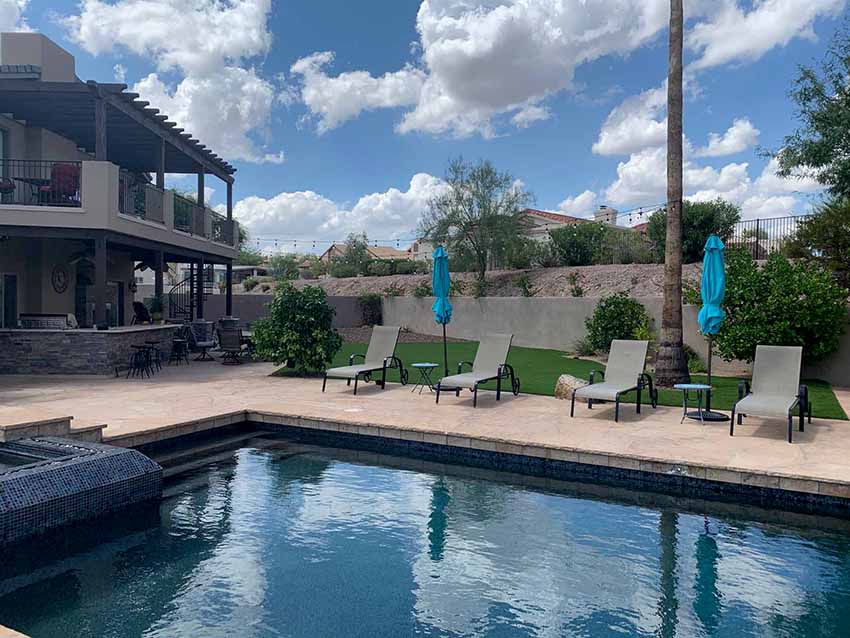
Artificial grass drainage is a connected system
Think of drainage as a route, not a single product feature. Rain first passes through the turf backing. Beneath it, the base supports the surface and helps water move toward the underlying soil or a planned drainage outlet. The site’s slope influences where that water goes.
A restriction anywhere along that route can cause trouble. Drainable backing cannot fix a low spot, an unsuitable base or an outlet that sits too high. Likewise, a well-built base cannot compensate for runoff being directed toward the house. The installation should be planned around the whole yard, including water arriving from roofs, patios and neighboring higher ground.
The base must balance stability and water movement
The base gives turf a firm, even foundation, but not all aggregate materials drain alike. Particle size, the amount of fine material and compaction affect how water moves. Material that locks together firmly may pass water differently from a more open aggregate. The right choice depends on the site and the intended drainage route.
The soil below the base matters just as much. Some Arizona yards have dense soil or caliche that limits infiltration. Adding a drainable layer above slow-draining ground does not make that ground absorb water faster; water still needs somewhere to go. Base depth and any additional drainage measures should follow a site assessment rather than a one-size-fits-all formula.
Compaction should provide support without being treated as a substitute for drainage design. Leaving the base loose to encourage drainage can lead to settlement, while poorly selected or unevenly placed material can create wet pockets and surface dips.
Slope gives water a destination
A lawn can look level while still having a gentle, deliberate fall. That grading helps direct water toward a suitable receiving area or drainage feature. The needed slope depends on the property’s elevations, soil, adjacent structures and available discharge route—not just the turf’s dimensions.
Monsoon storms can bring water faster than the ground absorbs it. The plan should account for that excess flow without sending it toward foundations, doorways or neighboring property. Where gravity drainage is difficult, additional drainage design may be needed before turf goes down.
- Locate existing low spots and places where water collects after rain.
- Account for runoff from downspouts, patios and other hard surfaces.
- Keep existing drainage paths and drain inlets from being buried or blocked.
- Confirm where collected water will discharge and whether that route is permitted.
- Check the finished turf elevation against nearby paving, thresholds and drains.
Turf backing is the entry point, not the entire solution
Turf products use different backing designs to let water pass through. Some rely on drainage openings, while others use more broadly permeable construction. Ask how the proposed product drains and how its installation requirements fit the planned base and grading.
A published drainage rate for a turf product does not establish how quickly a finished yard will drain. Real-world performance also depends on the base, underlying soil, infill condition, outlets and incoming runoff. Seams, attachment methods and transitions should follow the product’s installation requirements without interrupting the intended water path.
Drainage also should not be confused with cooling. Artificial turf can become hot in Arizona’s direct sun, even when it drains well. If you rinse it for cleaning or temporary cooling, that water still needs the same reliable route out.
Plan for dust, maintenance and the next monsoon
Windblown dust, leaves and other debris can accumulate on turf and around drain inlets. Remove debris and follow the turf manufacturer’s care instructions. After storms, look for recurring puddles, sediment buildup or newly uneven areas. Persistent standing water deserves an inspection rather than an assumption that more rinsing will solve it.
Before installation, ask for an explanation of the proposed base, grading and water destination. If the yard already floods, share photos taken during or after rain. Those observations can help identify problems that are not visible during a dry-weather visit.
Artificial Grass Arizona is based in Cave Creek and serves 22 cities across the Phoenix metropolitan area. Book a free on-site estimate to discuss your yard’s elevations, soil and drainage needs before choosing the installation approach.
Quick answers.
- Does artificial grass let rainwater through?
- Drainable turf backing lets water pass through, but the finished lawn also needs a suitable base and a path into the soil or toward an outlet. Backing alone cannot prevent puddles.
- Does every artificial grass installation need a drain?
- Not necessarily. Some sites can manage water through soil infiltration and grading; others need additional drainage. Soil conditions, runoff volume, elevations and the available discharge route determine the approach.
- Why does artificial grass puddle after rain?
- Possible causes include low spots, base settlement, slow-draining soil, restricted outlets or accumulated debris. A heavy storm can also temporarily exceed the system’s capacity. Recurring or persistent puddles should be inspected.