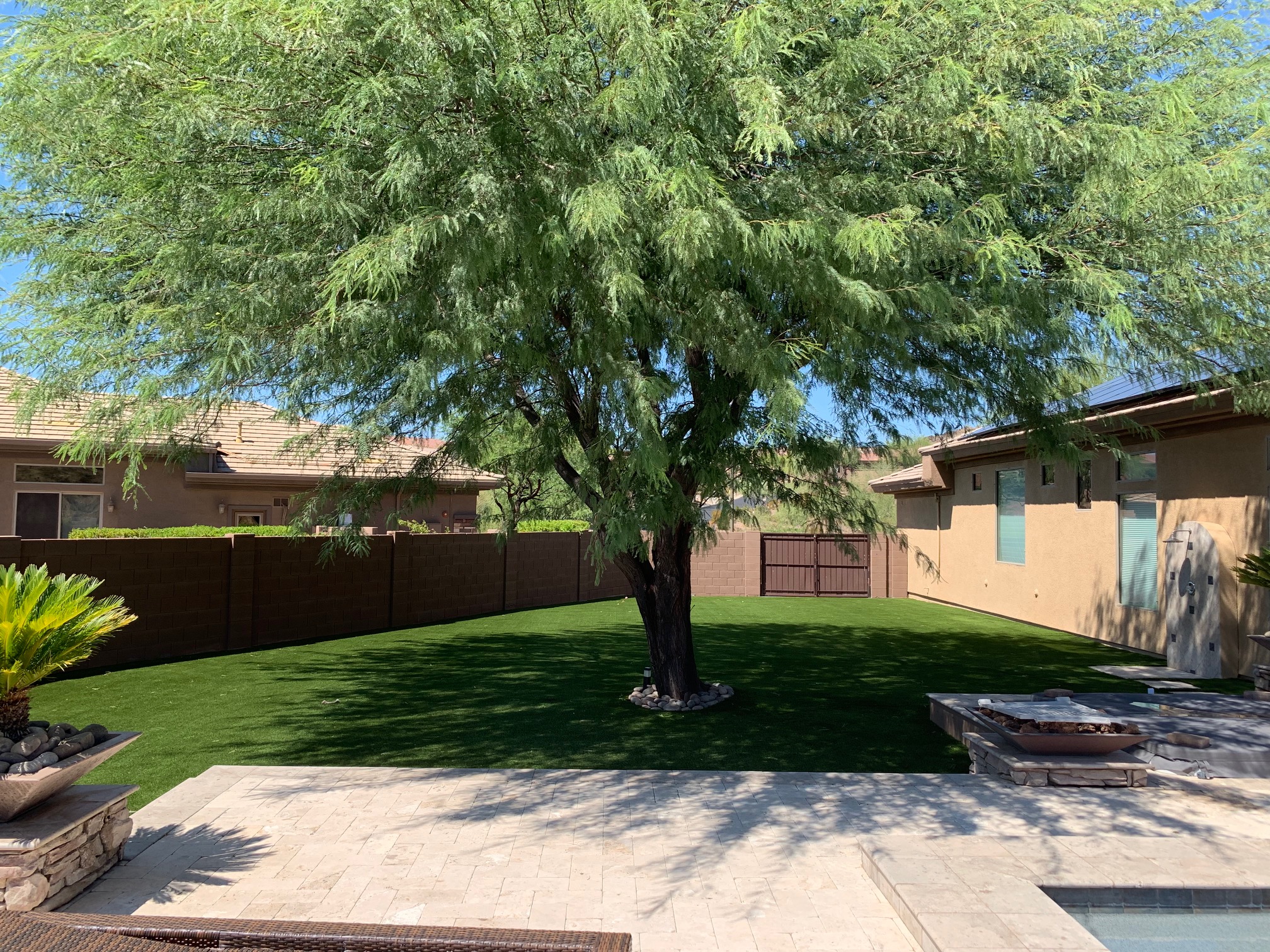
1. Artificial grass installation starts with site planning and excavation
Before removing existing landscaping, the installer should assess access, soil conditions, irrigation, nearby trees and where rainwater currently flows. Finished turf height also matters: the new surface needs to meet patios and walkways appropriately without blocking drains or creating awkward transitions.
Excavation removes existing grass, roots, debris and enough soil to accommodate the planned base and turf system. There is no single excavation depth that fits every Arizona yard. Existing elevations, soil stability and drainage needs determine how much material must come out. Buried utilities and irrigation lines should be identified before digging.
- Confirm which plants, trees and landscape features will remain.
- Identify irrigation lines that need to be protected, capped or rerouted.
- Plan access for equipment, material delivery and debris removal.
- Establish where runoff should go during monsoon storms.
2. Build a stable base and a workable drainage path
Once excavation is complete, the exposed ground is checked for soft areas, unevenness and drainage problems. A suitable aggregate base is then placed, graded and compacted in layers appropriate to the material and equipment. The goal is a firm, even foundation that supports the turf without preserving unwanted dips or bumps.
Drainage involves the entire installation—not just whether water can pass through the turf backing. Water also needs a route through or across the base and toward an appropriate outlet. Compacted native soil, low spots and enclosed courtyards may require additional drainage planning.
In Arizona, dry weather can hide drainage problems until a monsoon storm arrives. Ask how the proposed grading handles water near foundations, patios and neighboring properties. Turf should not be treated as a cure for an existing drainage issue.
3. Lay out the turf before making final cuts
The installer lays out the turf and allows it to relax as recommended for the product before final fitting. Layout should account for roll sizes, borders, obstacles and the direction the blades lean. Keeping that direction consistent helps adjacent pieces look uniform; mismatched orientation can make sections appear different in color.
Careful fitting around curves, trees and hardscape takes time. Pieces should meet cleanly without being forced into position. Fewer seams can be helpful, but avoiding every seam is not always practical. Yard shape, access and material use all influence the layout.
Artificial Grass Arizona uses USA-made turf selected and tested for Arizona's extreme heat. That does not mean the surface stays cool: artificial turf can become hot in direct sun. Product choice and installation planning should account for shade, intended use and when people or pets will use the space.
4. Join seams and secure the perimeter
Where turf pieces meet, the installer trims the edges and aligns them so the joint does not have an obvious gap or overlap. The pieces are joined using a seam system appropriate to the product and site. Blades should be kept clear of the joining area rather than trapped beneath it.
Perimeter attachment depends on the edge condition and installation design. A border beside concrete may need a different approach from an edge beside a planting bed. The objective is secure, neat edges without exposed fastening points or raised areas that could catch a foot.
Seam alignment and edge fitting are worth checking before infill goes down. Infill cannot correct a poorly cut joint, inconsistent blade direction or an unstable base.
5. Spread infill and brush it into the fibers
Infill is material distributed between the turf blades. Depending on the turf system, it helps support the fibers, adds weight and influences how the surface feels underfoot. The type and quantity should follow the selected product's requirements and suit the intended use, including whether the area will serve pets.
Installers spread infill in controlled passes and brush it down into the turf rather than leaving piles on top. Brushing also helps lift fibers flattened during transport and installation. Even distribution matters: too little or too much infill can affect the finished surface.
Ask which infill is proposed, why it suits your yard and what maintenance it needs. Do not assume any infill makes turf cool enough for bare feet or paws in Arizona's afternoon sun. Check surface temperature before use and plan for shade or different use times when necessary.
6. Review the finished installation and ongoing care
A final walkthrough should cover seams, edges, transitions, surface evenness and the intended drainage route. Ask for product-specific care instructions. Turf still needs debris removal, occasional brushing and cleaning suited to its use. Arizona dust can accumulate, and monsoon runoff can leave sediment or debris that warrants inspection.
Installed turf from Artificial Grass Arizona starts at $4.99 per square foot. Final pricing depends on site conditions, access, base preparation, drainage, turf grade and project details. A useful proposal makes those project needs clear rather than treating every yard as the same job.
The turf product carries a 15-year manufacturer warranty, while installation labor carries a separate 2-year workmanship warranty. Artificial Grass Arizona is based in Cave Creek and serves 22 cities across the Phoenix metropolitan area; financing is available. Book a free on-site estimate to review your excavation, drainage and installation needs.
Quick answers.
- Can artificial grass be installed directly over existing grass?
- For a conventional professional installation, existing grass and unsuitable material are removed first. Leaving vegetation underneath can create an unstable foundation as it decomposes and makes proper grading and base preparation difficult.
- Will artificial grass installation fix standing water?
- Not by itself. Standing water requires an assessment of soil, grading and drainage outlets. Water passing through the turf backing still needs somewhere to go beneath or beyond the installation.
- Does every artificial grass product need the same infill?
- No. Infill type and quantity depend on the turf system and intended use. Ask the installer to explain the product's requirements, the proposed infill and its maintenance needs.